Cheadle Property Market Update – April 2026 | House Prices, Sales & Rental Trends in SK8 & SK3
What the National Property Market Is Telling Us
There’s something about the clocks going forward and the evenings getting lighter that always makes the housing market feel a little more active.
Spring has traditionally been the time of year when many homeowners begin thinking seriously about moving, and early signs suggest that pattern is continuing in 2026.
While the first few months of the year have been steady rather than spectacular, the market has shown encouraging signs of stability as buyers and sellers continue to adjust to higher mortgage rates and changing affordability compared with recent years.
In fact, March proved to be one of our busiest months for several years, both in terms of new homes coming to the market and properties successfully sold. It’s a good reminder that even in a more measured market, well-presented homes launched with the right pricing and marketing strategy can still generate strong interest from buyers.
That said, the wider economic backdrop cannot be ignored. Ongoing global uncertainty and its potential impact on inflation, interest rates and consumer confidence — could influence how the housing market performs as the year progresses, so those thinking of moving may want to consider bringing those plans forward.
To understand what this might mean locally, it’s helpful to first look at the national picture and what the latest property indices are telling us about the UK housing market, before examining the trends emerging across Cheadle, Cheadle Hulme, Gatley, Edgeley and Cheadle Heath.
In our February Cheadle Property Market Update, we discussed how buyer demand had remained resilient despite higher mortgage rates, a trend that still appears to be influencing the market as we move further into 2026.
Cheadle Property Market – April 2026 Snapshot
UK House Prices – A Market That Is Stabilising
Most of the major indices now show modest price growth rather than sharp increases or falls.
The Halifax House Price Index reports that the average UK home is now worth £301,151, with prices increasing 0.3% in February and 1.3% over the past year.
Meanwhile, Zoopla’s House Price Index suggests the average UK property currently sits around £269,900, also showing annual growth of 1.3%.
When we look at the ONS / Land Registry figures, the average UK house price is slightly lower at roughly £268,000, reflecting completed sales rather than mortgage approvals or asking prices.
These differences are normal because each index measures the market at a slightly different stage:
• Rightmove – asking prices of new listings
• Nationwide / Halifax – mortgage lending data
• ONS / Land Registry – completed sales
Taken together, they show a clear picture:
The UK housing market isn’t booming, but it isn’t falling either. It’s gradually finding a new balance.
Asking Prices Rise as the Spring Market Begins
Rightmove’s latest data suggests the traditional spring selling season is now underway.
The average asking price of newly listed homes rose 0.8% in March, pushing the national average to around £371,000.
This type of increase is typical at this time of year as more homeowners choose to list their properties during the stronger spring and early summer months.
However, one important change compared with previous years is that supply has increased significantly.
There are now more homes available for sale than at any point in the last decade, which means buyers have more choice and sellers must price their homes more carefully.
For sellers, this reinforces a point we have discussed in previous updates:
Pricing strategy matters more than ever.
Modest Growth Expected for 2026
Looking ahead, most forecasts suggest steady but unspectacular house price growth this year.
Several major forecasts include:
• Zoopla – around 1.5% growth during 2026
• Halifax – roughly 1–3% annual growth
• Nationwide – potentially 2–4% growth if affordability improves
• Rightmove – around 2% increase in asking prices by year-end
These projections all point toward the same conclusion:
The housing market is expected to grow slowly rather than dramatically.
After the volatility of the pandemic years and the mortgage rate shock of 2023–2024, the market now appears to be entering a period of gradual adjustment and stabilisation.
Mortgage Rates and Economic Uncertainty
Mortgage affordability remains one of the biggest influences on buyer behaviour.
Although inflation has eased compared with previous years, global economic uncertainty and rising energy prices mean interest rate expectations remain unpredictable.
Recent market volatility has pushed some mortgage rates slightly higher again, which can make buyers more cautious when making purchasing decisions.
This doesn’t necessarily mean the market will slow dramatically, but it does mean that buyers are becoming more price-sensitive and deliberate when choosing a property.
Supply Is Increasing – Giving Buyers More Choice
One of the most significant shifts in the national market during the past year has been the increase in available homes for sale.
Rightmove data shows the number of homes on the market is now at its highest level for more than a decade, which has helped restore some balance between buyers and sellers.
This has two important consequences:
1️⃣ Buyers can take longer to make decisions
2️⃣ Sellers must launch their properties with the right price and presentation
Homes that are well priced and well presented continue to sell quickly.
Those that enter the market too high often struggle to regain momentum later.
First-Time Buyers Remain a Key Driver of Activity
Despite affordability challenges, first-time buyers continue to play a major role in the UK housing market.
Improving wage growth, stabilising mortgage rates and increased housing supply have helped keep this part of the market moving.
Many analysts believe this group will remain one of the key drivers of housing market activity throughout 2026.
What Does This Mean for Local Property Markets?
While national data provides an important overview, property markets ultimately remain highly local.
Prices, demand and buyer behaviour can vary significantly between regions and even between neighbouring towns.
Northern markets, including parts of the North West of England, are widely expected to see stronger performance than some southern regions due to better affordability and continued buyer demand.
This brings us to the key question:
What is actually happening in the Cheadle property market right now?
In the next section we look at the latest data for SK8 and SK3, including buyer demand, local price trends and the types of properties currently attracting the strongest interest.
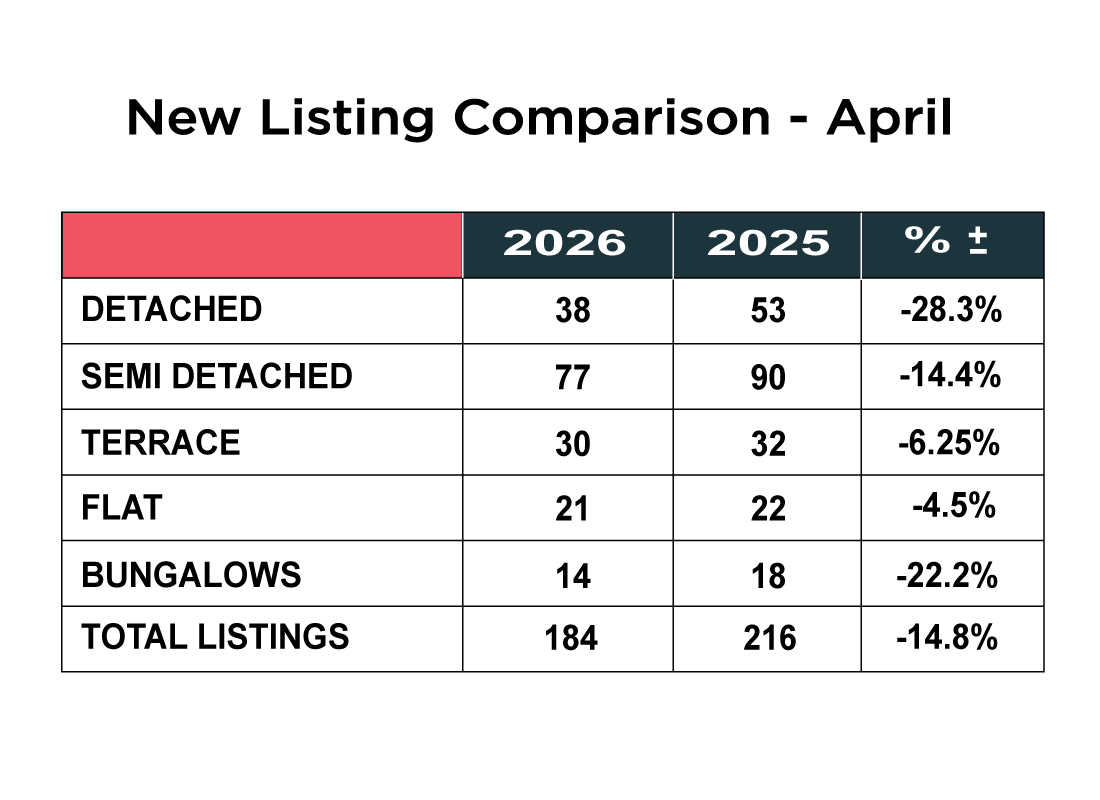
New Listings in SK8 & SK3 – Supply Down Year-on-Year
One interesting trend emerging locally this spring is a reduction in the number of new homes coming onto the market compared with the same period last year.
Across SK8 and SK3, 184 properties have been listed so far in 2026, compared with 216 during the same period in 2025 — a 14.8% drop in new supply.
Looking at the breakdown by property type, the biggest reductions have been in the detached and bungalow sectors. Detached listings have fallen from 53 to 38 homes, a drop of 28.3%, while bungalows have declined from 18 to 14, down 22.2% year-on-year.
The core family housing market, particularly semi-detached homes, has also seen fewer listings, dropping from 90 to 77 properties (-14.4%).
By contrast, the lower price brackets have remained relatively steady, with terraced homes down only slightly from 32 to 30 listings, and flats from 22 to 21.
Overall, the data suggests that while national headlines often talk about increasing supply, locally fewer homeowners have chosen to list their properties so far this year, particularly in the higher value segments of the market.
From our experience on the ground, when supply tightens like this, well-priced homes that launch with a strong marketing strategy can attract significant early interest.
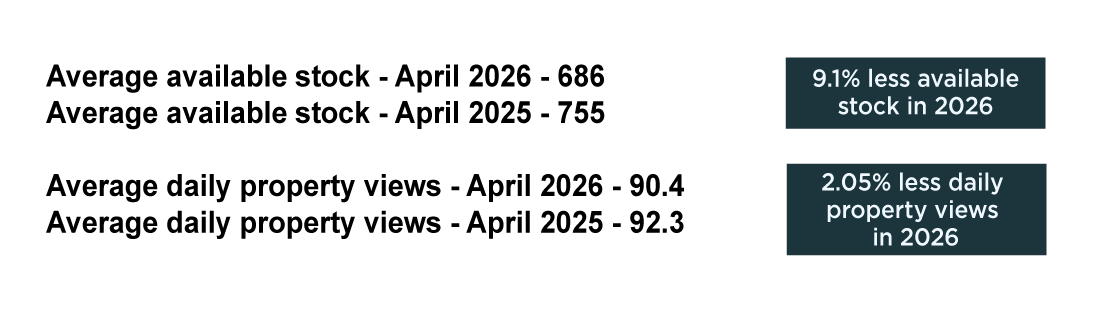
Stock Levels and Buyer Activity
Another useful way to understand the health of the local market is to look at the balance between available stock and buyer activity.
Across SK8 and SK3, the average number of properties available for sale in April 2026 stands at 686, compared with 755 during the same period last year. That represents a 9.1% reduction in available stock.
In simple terms, there are fewer homes available for buyers to choose from than there were a year ago.
Buyer activity, however, has remained broadly consistent. The average number of daily property views sits at 90.4, only slightly lower than 92.3 views per day recorded in April 2025 — a modest 2.05% reduction.
Taken together, these figures suggest that demand has remained relatively stable while supply has tightened, which can help support pricing levels where properties are positioned correctly.
From our perspective locally, this balance between supply and demand reinforces the importance of launching a property with the right pricing and marketing strategy from day one.
Key takeaway:
There are fewer homes available for sale locally than last year, while buyer activity has remained broadly steady — a combination that can create strong competition for well-priced homes.
Cheadle House Prices – Latest Property Values in SK8 & SK3
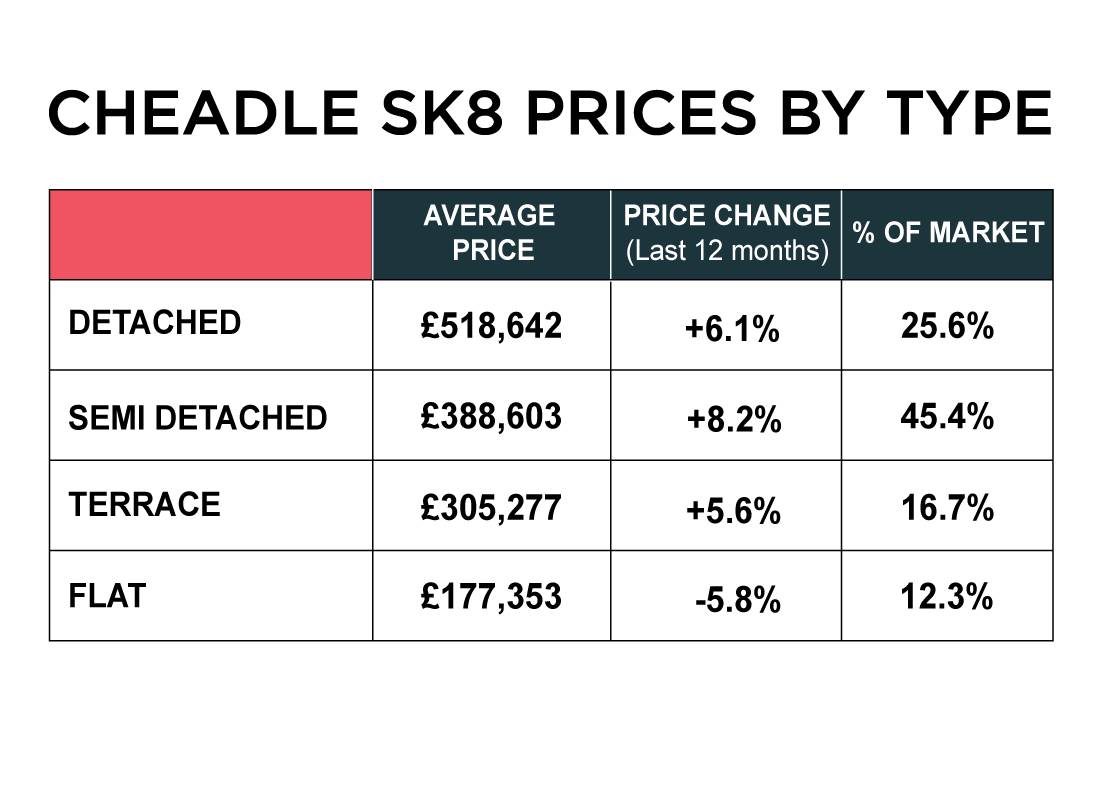
Property Prices in Cheadle (SK8)
Turning to the SK8 area, the data shows steady price growth across most property types over the past year, particularly within the core family housing market.
The average detached home in SK8 now stands at £518,642, reflecting 6.1% growth over the past 12 months. Detached houses represent around a quarter of the local housing stock, highlighting the strong presence of higher-value family homes across the area.
Semi-detached properties — which form the largest part of the local market at 45.4% of stock — have seen prices increase 8.2%, bringing the average value to £388,603.
Terraced homes have also experienced steady growth, with average prices rising 5.6% to £305,277, while flats have seen a 5.8% reduction over the past year, with average values now sitting at £177,353.
The softer performance of flats reflects a trend seen in many markets, where buyers remain more cautious around apartments due to leasehold considerations, service charges and mortgage lending criteria.
Key takeaway:
House prices across SK8 have continued to grow over the past year, particularly in the core family housing sectors, while flats remain a more price-sensitive part of the market.
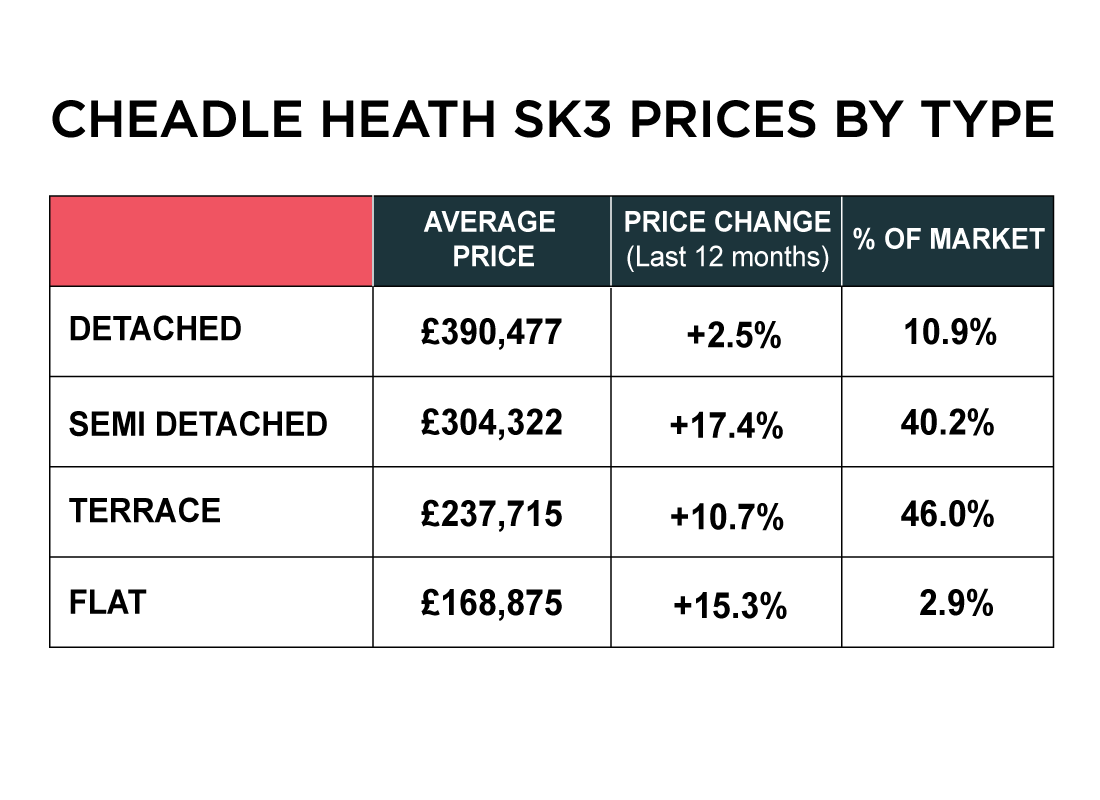
Property Prices in Cheadle Heath (SK3)
Looking at average prices across Cheadle Heath, the data shows steady growth across most property types over the past 12 months, with particularly strong increases in the core family housing market.
The average detached home now stands at £390,477, showing a modest 2.5% increase, although detached properties represent a relatively small part of the local market at around 11% of housing stock.
The semi-detached sector, which forms the backbone of the local family market, has seen the strongest growth with prices rising 17.4% to an average of £304,322. This segment accounts for just over 40% of the housing stock, highlighting its importance to the area’s property market.
Terraced homes — the largest segment of the market at 46% of stock — have also performed well, with average prices increasing 10.7% to £237,715.
Meanwhile, flats have recorded a 15.3% increase, with average values now sitting at £168,875, although apartments represent only a small proportion of the local housing mix.
Overall, the figures reinforce how the mid-market family housing sector continues to drive activity and price growth locally.
Key takeaway:
The strongest price growth locally is being seen in the core family housing market, particularly semi-detached homes — which make up a large proportion of the housing stock in Cheadle Heath.
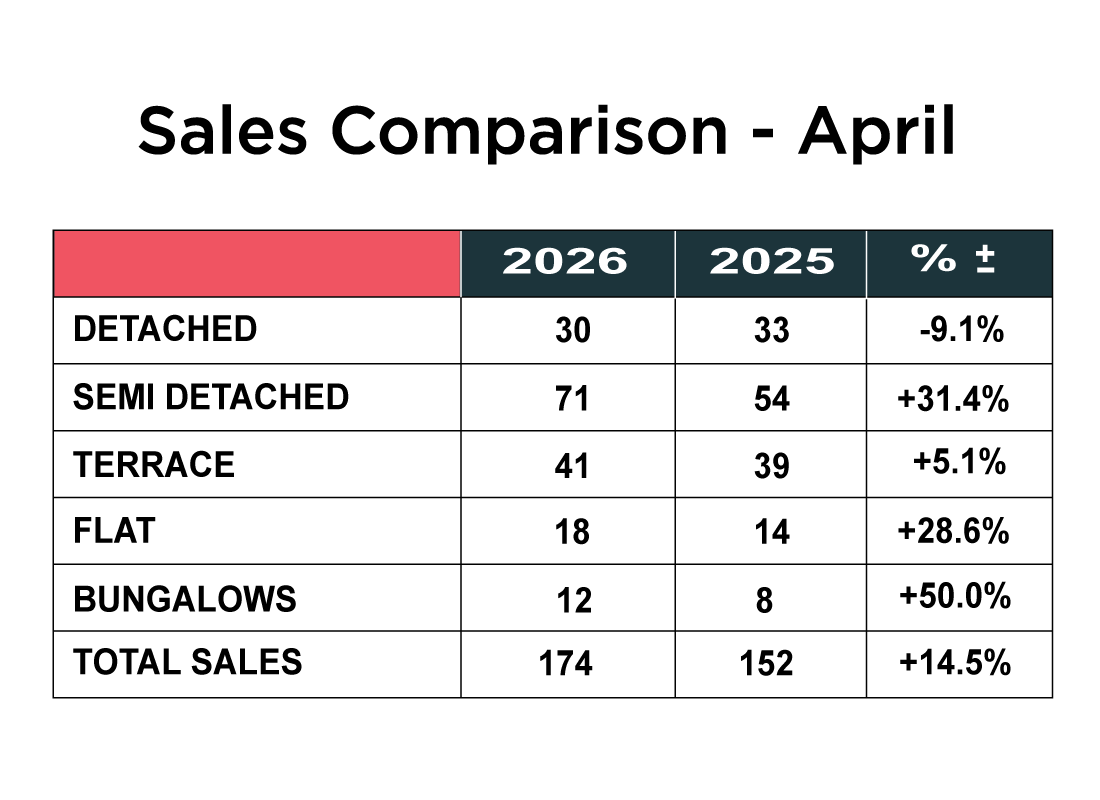
Sales Activity – Transactions Up Compared with Last Year
Despite fewer new listings coming to the market this year, sales activity across SK8 and SK3 has actually increased compared with the same period in 2025.
A total of 174 homes have sold so far in 2026, compared with 152 during the same period last year, representing a 14.5% increase in completed sales.
The strongest growth has been seen in the semi-detached sector, where sales have risen from 54 to 71 properties, an increase of 31.4%. Given that semi-detached homes form the backbone of the local family market, this highlights the continued strength of demand from buyers looking to upsize.
Terraced homes have also seen a modest increase in activity, rising from 39 to 41 sales, while flat sales have increased from 14 to 18, suggesting some renewed activity in the lower price brackets.
The bungalow market, although smaller in overall numbers, has also seen a notable increase, with 12 sales recorded compared with 8 last year.
Detached homes remain the only sector showing a slight reduction in transactions, with 30 sales compared with 33 last year, reflecting the more price-sensitive nature of the higher-value market.
Key takeaway:
Even though fewer homes have come to the market locally this year, the number of sales has increased — suggesting that well-priced homes are still finding buyers.
Local Market Insight
When we look at the data across all the charts together, an interesting picture begins to emerge.
While new listings have fallen and available stock has reduced, the number of completed sales has actually increased compared with the same period last year.
This suggests that demand in the local market remains relatively resilient, particularly for well-presented homes in the core family housing sectors.
Markets like this tend to reward sellers who launch their property with the right pricing strategy and strong marketing exposure, as buyers are still actively searching but have become more selective.
From our experience locally, the first few weeks of marketing remain the most critical period for generating interest and securing the strongest offers.
Thinking of Moving in 2026?
If you are considering selling your home in Cheadle, Cheadle Hulme, Gatley, Edgeley or Cheadle Heath, understanding the current market conditions can make a significant difference to the outcome of your sale.
Every property and every move is different, which is why we take the time to create a tailored pricing and marketing strategy for each home we bring to the market.
If you would like to understand what your home might be worth in today’s market, we would be happy to provide a confidential, no-obligation valuation.
👉 Book a valuation and strategy meeting here
Related Articles:
Cheadle House Prices Update February 2026
Selling your Cheadle home? Why fees matter!
The selling strategy that helped achieve £10,000 more
Share this article
More Articles
Sign up for our newsletter
Subscribe to receive the latest property market information to your inbox, full of market knowledge and tips for your home.
You may unsubscribe at any time. See our Privacy Policy.

